Vermont Covered Bridges – Here’s Your “See-at-a-Glance” Guide
Vermont Covered Bridges are considered historic landmarks, and remain one of the most popular attractions in the state. There are over 100 covered bridges in Vermont, the second highest number in any state, and in this guide you’ll find listed all the ones you can visit with trespassing!
To people today these Vermont Covered Bridges seem like works of art, but in reality when the bridges were built they were covered for purely functional reasons.
Made of wood, a Vermont bridge would last three times as long if covered – especially when subjected to the harsh New England winters.
The more romantics suggested the bridges were covered in order to provide a place to court your lady and secretly give her a kiss – hence the nickname given to covered bridges of “Kissing Bridges.” But life’s too short to argue over why so many of Vermont’s bridges were covered, so instead I’ll spend my time enjoying the fact that somebody did bother to cover them, and most survived for future generations to enjoy.
I’ve split the listings into the same regions I’ve used throughout my Vermont section. So see where they are, make your choices and plan to visit as many as possible during your Vermont vacation.
Let’s get going…
Southern Vermont Covered Bridges:
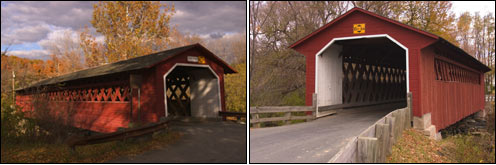
The Henry and Silk Bridges are both in Bennington and classic examples of Vermont Covered Bridges. The Henry Bridge was built in 1840 and the Silk in 1889. Both span the scenic Walloomsac River.
More Southern Vermont Covered Bridges…
|
Southern Vermont Covered Bridges
|
|||
|
Name
|
County
|
Town
|
Date Built
|
| Paper Mill |
Bennington
|
Bennington
|
1840 (Rebuilt)
|
| Silk or Locust Grove |
Bennington
|
Bennington
|
1889
|
| Henry |
Bennington
|
Bennington
|
1840
|
| Chiselville |
Bennington
|
Arlington
|
1870
|
| Bridge at the Green |
Bennington
|
Arlington
|
1852
|
| Creamery or Centerville |
Windham
|
Brattleboro
|
1879
|
| West Drummerston |
Windham
|
Drummerston
|
1872
|
| Kidder Hill |
Windham
|
Grafton
|
1870
|
| Green River |
Windham
|
Guilford
|
1870
|
| Williamsville |
Windham
|
Newfane
|
1870
|
| Bartonsville |
Windham
|
Rockingham
|
1870
|
| Hall, Barber Park or Osgood |
Windham
|
Rockingham
|
1970 (Rebuilt)
|
| Victorian Village |
Windham
|
Rockingham
|
1967
|
| Worralls |
Windham
|
Rockingham
|
1868
|
| Scott |
Windham
|
Townshend
|
1870
|
| Twin Silos |
Windham
|
Wilmington
|
1949
|
Central Vermont Covered Bridges:
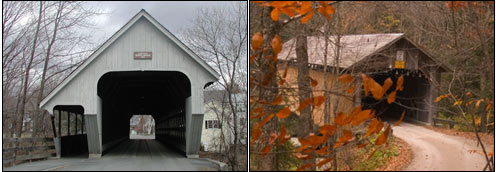
On the left is Middle Bridge spanning the Ottauquechee River in the beautiful village of Woodstock. Historic Brown Bridge spans the Cold River in Shrewsbury and was built in 1880 by Nicholas Powers. These are just two Vermont covered bridges you can see in the central region of the state.
Here’s more central Vermont Covered Bridges…
|
Central Vermont Covered Bridges
|
|||
|
Name
|
County
|
Town
|
Date Built
|
| Coburn or Cemetery |
Washington
|
East Montpelier
|
1851
|
| Mosely |
Washington
|
Northfield
|
1899
|
| Slaughter House |
Washington
|
Northfield
|
1872
|
| Station, Northfiled Falls |
Washington
|
Northfield
|
1872
|
| Second, Newell or Lower Cox Brook |
Washington
|
Northfield
|
1872
|
| Third or Upper Cox Brook |
Washington
|
Northfield
|
1872
|
| Pine Brook or Wilder |
Washington
|
Waitsfield
|
1872
|
| Village or Big Eddy |
Washington
|
Waitsfield
|
1833
|
| Warren |
Washington
|
Warren
|
1879
|
| Station |
Addison
|
Cornwall
|
1856
|
| Halpin or High |
Addison
|
Middlebury
|
1824
|
| Pulpmill |
Addison
|
Middlebury
|
1808-1820
|
| Rutland Railroad |
Addison
|
East Shoreham
|
1897
|
| Moxley or Guy |
Orange
|
Chelsea
|
1886
|
| Gifford or C.K. Smith |
Orange
|
Randolph
|
1904
|
| Barley, Upper Blaisdell or Johnson |
Orange
|
Randolph
|
1904
|
| Hyde or Kingsbury |
Orange
|
Randolph
|
1904
|
| Sayers |
Orange
|
Thetford
|
Unknown
|
| Union Village |
Orange
|
Thetford
|
1867
|
| Howe |
Orange
|
Tunbridge
|
1879
|
| Mill, Hayward or Noble |
Orange
|
Tunbridge
|
1883 (Rebuilt)
|
| Ciley or Lower |
Orange
|
Tunbridge
|
1883
|
| Larkin |
Orange
|
Tunbridge
|
1902
|
| Flint |
Orange
|
Tunbridge
|
1845
|
| Sanderson or Lower |
Rutland
|
Brandon
|
1838
|
| Depot |
Rutland
|
Brandon
|
1840
|
| Kingsley or Mill River |
Rutland
|
Clarendon
|
1838
|
| Cooley |
Rutland
|
Pittsford
|
1849
|
| Hammond |
Rutland
|
Pittsford
|
1843
|
| Gorham or Goodnough |
Rutland
|
Pittsford
|
1841
|
| Twin |
Rutland
|
Rutland
|
1850
|
| Brown |
Rutland
|
Shrewsbury
|
1880
|
| Bests |
Windsor
|
West Windsor
|
1890
|
| Bowers or Brownsville |
Windsor
|
West Windsor
|
1919
|
| Martinsville or Martin’s Mill |
Windsor
|
Hartland
|
1881
|
| Willard |
Windsor
|
Hartland
|
1870
|
| Baltimore |
Windsor
|
Springfield
|
1870
|
| Salmond |
Windsor
|
Weathersfield
|
1875
|
| Downers |
Windsor
|
Weathersfield
|
1840 (Restored)
|
| Titcomb or Stoughton |
Windsor
|
Weathersfield
|
1880
|
| Lincoln |
Windsor
|
Woodstock
|
1865
|
| Middle |
Windsor
|
Woodstock
|
1969
|
| Taftsville |
Windsor
|
Woodstock
|
1836
|
Northern Vermont Covered Bridges:
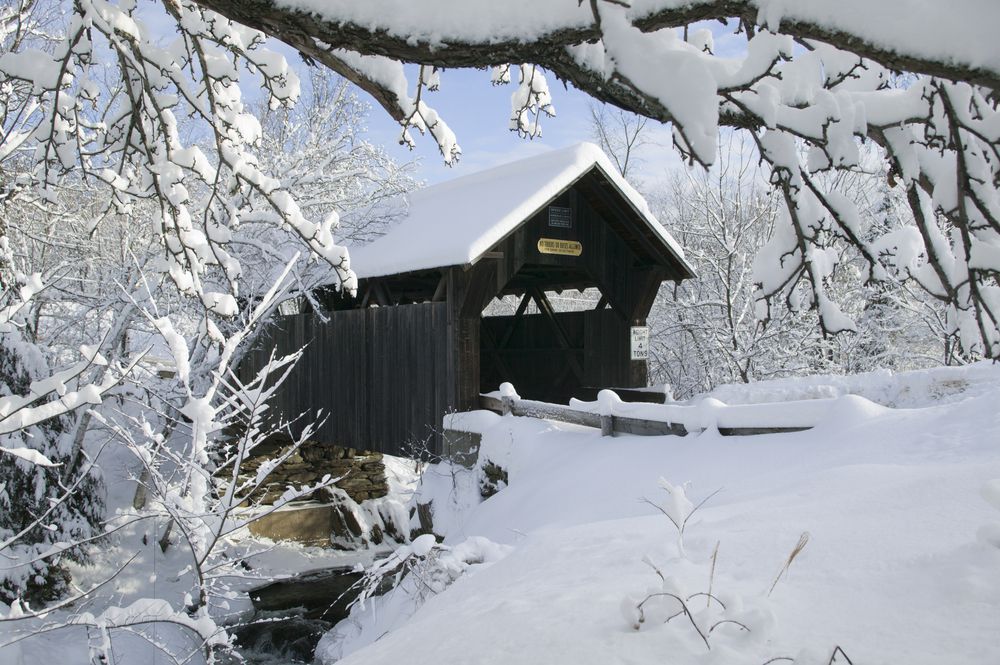
Emily’s Bridge in Stowe is on all the bus tours in the area. Named after a girl who took her own life after being deserted by her lover. Emily makes her presence felt in various ways to visitors. This bridge is especially picturesque in the coating of an early winter storm.
More Northern Vermont Covered Bridges…
|
Northern Vermont Covered Bridges
|
|||
|
Name
|
County
|
Town
|
Date Built
|
| Mill, Junction or Lower |
Lamoille
|
Belvidere
|
Unkown
|
| Morgan or Upper |
Lamoille
|
Belvidere
|
1887
|
| Gates Farm or Little |
Lamoille
|
Cambridge
|
1897
|
| Poland or Junction |
Lamoille
|
Cambridge
|
1887
|
| Scott, Grist Mill or Bryant |
Lamoille
|
Cambridge
|
Unknown
|
| Power House or School Street |
Lamoille
|
Johnson
|
1870 (Rebuilt)
|
| Scribner or Mudget |
Lamoille
|
Johnson
|
Unknown
|
| Red or Sterling |
Lamoille
|
Morristown
|
1896
|
| Emily’s, Stowe Hollow or Gold Brook |
Lamoille
|
Stowe
|
1844
|
| Village or Church Street |
Lamoille
|
Waterville
|
1877
|
| Jaynes, Upper or Codding Hollow |
Lamoille
|
Waterville
|
1877
|
| Montgomery, Lower or Potter |
Lamoille
|
Waterville
|
1870
|
| Fisher, Chubb or Chub |
Lamoille
|
Wolcott
|
1908
|
| Hopkins |
Franklin
|
Enosburgh
|
1875
|
| Lower or Maple Street |
Franklin
|
Fairfax
|
1865
|
| East Fairfield |
Franklin
|
Fairfield
|
1865
|
| Fuller or Blackfalls |
Franklin
|
Montgomery
|
1890
|
| Comstock |
Franklin
|
Montgomery
|
1883
|
| West Hill, Creamery or Crystal Springs |
Franklin
|
Montgomery
|
1883
|
| Longley, Harnois or Head |
Franklin
|
Montgomery
|
1893
|
| Hectorville |
Franklin
|
Montgomery
|
1883
|
| Hutchins |
Franklin
|
Montgomery
|
1883
|
| Lord’s Creek |
Orleans
|
Irasburg
|
1881
|
| Orne |
Orleans
|
Irasburg
|
1881 (Rebuilt)
|
| River Road, School or Upper |
Orleans
|
Troy
|
1910
|
| Green Bank Hollow |
Caledonia
|
Danville
|
1886
|
| Chamberlin or Whitcomb |
Caledonia
|
Lyndon
|
1878
|
| Miller’s Run or Bradley |
Caledonia
|
Lyndon
|
1887
|
| Randall or Burrington |
Caledonia
|
Lyndon
|
Unknown
|
| Sandborn |
Caledonia
|
Lyndon
|
1869
|
| Schoolhouse |
Caledonia
|
Lyndon
|
1879
|
| Holmes, Creek or Lakeshore |
Chittenden
|
Charlotte
|
1870
|
| Lower or Quinlan |
Chittenden
|
Charlotte
|
1849
|
| Sequin, Browen’s or Upper |
Chittenden
|
Charlotte
|
1849
|
| Shelburne Museum |
Chittenden
|
Shelburne
|
1845
|
| Brown’s River |
Chittenden
|
Westford
|
1837
|
Vermont Lodging Resources:
Vermont’s covered bridges are spread all other the state but most are within a short driving distance of towns and cities. It’s fun to make a tour from a central location.
Once you’ve chosen the areas you want to visit use the accommodation resource below to choose lodging that suits your budget and preference.
To discover where to stay deals, and compare rates and amenities with a trusted and professional travel organization then check out Vermont lodging and accommodations.